Bliss Kiss Simply Peel Latex Peel Off Cuticle Guard for Nail Art
THE CUTICLE
Practise you lot know where the cuticle is? Are you supposed to push, clip or scrape?
The correct answer might surprise you. It's "Scrape."
This is probably one of the almost of import articles you will read about nail care.
In this article, you'll learn:
- What and where the cuticle is
- Some important nail anatomy names
- How to remove the cuticle properly
We've Been Duped
The entire planet has been taught the wrong definition for the "cuticle".
The tight band of peel at the base of your boom plate is NOT the cuticle.
That band of skin is called the "keratinized proximal nail fold " or "blast fold".
In man anatomy, cuticle (sometimes confused with eponychium) refers to several structures. It refers to the layers of epidermal cells or keratinocytes that produce the horn poly peptide keratin, and besides to the superficial layer of overlapping cells covering the hair shaft (cuticula pili) that locks the pilus into its follicle (Encounter also Cuticle (hair). [Source: en.wikipedia.org]
So where is that elusive cuticle if what nosotros've been taught is incorrect?
The cuticle is asparse layer of dead tissue riding on the nail plate to form a seal between the smash plate and eponychium to forbid pathogens from infecting the matrix area.
The cuticle pulls abroad from the underside of the eponychium and attaches tenaciously to the smash plate.
The cuticle should NOT be confused with the "eponychium". ~Doug Schoon, Nail Construction and Product Chemical science
The Proximal Fold of the Eponychium
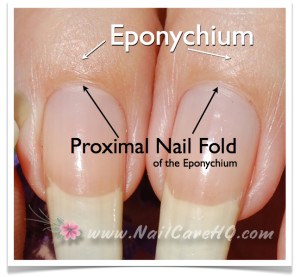
Please, please, please…DO Non CUT THIS Skin!
The proximal fold is a required guardian seal that prevents germs and bacteria from getting to the nail matrix, where new cells are created.
I e'er know when girls and women are clipping and nipping. Their unabridged cuticle line is red and inflamed. Basically, their eponychium is infected all the time.
If you go to a salon for a manicure, do not ever let your nail tech cutting this skin.
The best way to proceed this skin soft and tight to the boom plate is with a loftier quality, jojoba wax ester basedpenetrating nail and cuticle oil.
Where Does The Cuticle Come From?
How the cuticle is created is fascinating to me and sounds like information technology should be painful.
Simply information technology isn't.
The Expiry Grip
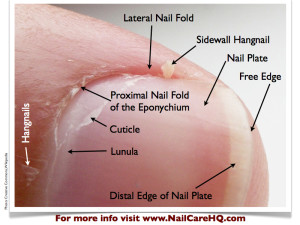
The eponychium is living pare that covers approximately 20% of the nail plate, right over the matrix.
The eponychium is a very important guardian seal preventing germs and bacteria from getting into the matrix.
Not surprisingly, the tissue that sits upon the smash plate is very different from the visible eponychium.
The underside of the eponychium nail fold has a strange, sticky texture. This is why it is so of import to NOT dig a tool underneath the nail fold.
As the blast cells are created and pushed frontwards, the blast plate literally rips the lesser layer of eponychium cells with it.
It is these cells that are the cuticle.
Cuticle cells too tightly grip the proximal fold of the eponychium. This creates a nice, tight guardian seal.
For some people, the proximal fold releases from the cuticle on its own.
For people like me, that death grip is too strong. My cuticle will pull the nail fold and stretch it out very thin.
In the photo to a higher place, yous can see both examples. One one-half of the proximal fold has released on its own and the other half is yet being stretched.
Most people tin't run into their cuticle since the peel is so thin, but this photograph captured it perfectly.
Breaking the Cuticle's Grasp – Push Back
Should you button back your proximal fold?
I do, but it's completely upwardly to you.
When you release the grip, your proximal fold is able to stay prissy and tight. As long as you don't push too hard with your fingernail, the good for you seal under the eponychium stays intact, and your matrix stays healthy.
You lot don't e'er want to push and so hard that your fingernail or tool goes under the proximal fold.
My Experiment
I did an experiment to figure all of this out. I stopped pushing back my nail folds for iii weeks to see what would happen.
The proximal folds were stretched an boosted3 millimeters! I also started getting those painful, thin hangnails that tear and bleed on my eponychium.
When I released the nail folds from the cuticle, the skin remained stretched out.
Within 24 hours that skin was drying out and I had a stiff desire to prune information technology.
Ah-ha!
I had finally figured out why people clip their proximal folds!
Geeky…but that was an heady discovery for me. Since I've always pushed back my proximal folds, I've never had the desire to clip earlier.
I started oiling and massaging that skin several times a day. Inside a week my proximal folds were dorsum to normal and looking beautifully healthy.
The Solution?
Simply utilise your fingernail to gently push button back the proximal fold to break the death grip about every 4 to 7 days.
If your nails are actually short, you tin apply an orangewood stick. Just be gentle.
If y'all keep your skin hydrated with a high quality, jojoba wax ester basedpenetrating smash and cuticle oil, and so it will be easy to push back your boom folds.
This can too be done in the shower. Just make sure you are wearing one coat of base glaze when showering.
Many of my readers know that my #1 Rule is "Never Shower Naked".
Proper Cuticle Removal
Since polish and nail enhancements don't bail to the skin on the nail plate, the cuticle should exist properly removed with gentle scraping.
Again, some people are able to scrape the cuticle off with their fingernail in the shower.
Others like to apply a cuticle remover.
How Cuticle Removers Work
The all-time ingredient to dissolve human protein cells is "lye". Yous'll also find information technology labeled as potassium hydroxide, sodium hydroxide, or caustic potash.
Lye is largely used in the soap making process. All cuticle removers incorporate lye.
Personally, I dear using a cuticle remover. Some people hate information technology.
Currently, I employ the Sally Hansen™ remover that looks like a blue gel. Another favorite of many nail artists is Blue Cantankerous™.
I've used Blue Cross™ and I hate it for three reasons. It's likewise watery, information technology eats my live pare, and causes those tiny strips of shredded skin below the proximal fold. You lot tin can see some of those hangnails in the photo farther upwardly in this article.
Lye Dissolves All Pare
The cuticle is dead skin.
The proximal blast fold is live pare.
Cuticle removers have no preference.
The directions on all cuticle removers tell you to apply information technology to simply the nail plate and exercise not let it touch your skin.
Equally many of you know, that is easier said than done.
I have much more control with a cream or gel type of remover. Watery removers wick all around on your live fingertip skin.
What'south In Your Toolbox?
Orangewood stick?
Plastic cuticle tool?
Or metallic cuticle tool that follows the bend of your nail plate?
Doug Schoon prefers that people use the orangewood stick. I call back it'southward most likely because the metal tool is widely driveling.
If y'all use too much downward pressure near the proximal nail fold, y'all tin cause damage to the matrix. This damage is often seen as white spots in the nail plate. These are boom bruises.
Personally, I similar the metallic, spoon-shaped tool. It's faster.
As a busy mom and baron, I don't ofttimes get the luxury to practise my nail care the slow way. I also use the tool correctly, which I explain in more than particular below.
Depending on your budget, endeavor different tools to see what you lot prefer. Yous might but find that using your own fingernail works well likewise.
The Solution?
For two years I have been looking for a solution to the strong, dissolving power of cuticle removers without dissentious my peel. And I finally found it.
Simply cover your skin with a layer of a liquid latex barrier,or watered downwardly white glue (25%/75%) if you take a latex allergy.
Permit it dry so you lot are gratuitous to apply cuticle remover safely.
From Beginning to Finish
-
- Apply your skin bulwark and allow to dry.
-
- Utilize the remover following the manufacturers'south directions.
-
- Using a cuticle removal tool–gently, gently, gently–scrape back and stop correct at the proximal fold. Glide the tool against the surface of your blast plate. The remover solution will have dissolved the cuticle so downward force per unit area is unnecessary.
-
- The cuticle volition build up on the back of the remover. Wipe that onto a paper towel.
-
- Plough the tool 90 degrees to your your nail plate, and slide the tool forth your proximal fold to scoop away the remaining cuticle and remover.
- One time you lot are finished, remove the barrier and rinse your hands with water.
In Decision
I hope y'all've found this commodity helpful.
Just recollect, with all of your nail care and nail enhancement product use… if information technology hurts… stop.
Follow United states on Instagram
Bring together the Blissette💋Nail Bar
Engage. Connect. Create. Laugh. Uplift. Observe Your Nail-Obsessed Tribe!If yous love nails, polish, boom art, You lot Belong AT THE BLISSETTE Boom BAR!
Shop Elation Kiss™ Products
Life-irresolute products with an exceptional customer experience. All Bliss Buss™ products come with a 100% satisfaction guarantee. Nosotros promise results that delight, or we'll make it right!Source: https://www.nailcarehq.com/cuticle/
0 Response to "Bliss Kiss Simply Peel Latex Peel Off Cuticle Guard for Nail Art"
Post a Comment